The British Settlement of Kenya 4 of 4
PART 4 - THE FINAL CHAPTER.
Despite the Mau-Mau being ruthlessly and violently crushed, the British Empire’s time in Kenya was rapidly running down. British moral authority had been degraded by sustained racist policies, periodic but regular atrocities, and the fact that much of the coutnry had been turned into an armed camp. The Lancaster House Conference and the release of Jomo Kenyatta were both stages on the way to a British exit.
Since settlement, with the twin effects of modern medicine and a growing economy, the local population of native Kenyans had exploded, while at the same time, restrictive policies and laughably incompetent attempts at reform had seen black Africans and migrant Indians locked out of both political and land rights. The land in particular was a major point of resentment, with white settlers sitting on sone of the best agricultural land on the continent, up in the white highlands - a legacy of Lord Delamere and his mission of anglicisation.
Of course, with the exit of the colonial administration looming, a solution needed to be found for the fact that only white settlers owned the best farmland. Eventually, the British Government agreed to purchase all of the white owned farms and give the title deeds to the Government of Kenya, which they mostly did. Soysambu Estate, still the property of Lord Delamere’s descendants, was excluded from this arrangement, along with a handful of other very large estates.
Of course, the government tried to do this on the cheap. My family’s farm is a good example of this. The British government valued the farm at 22 pounds an acre but claimed that the exchequer could not afford to pay for all the improvements our family had made. So they offered 11 pounds an acre, take it or leave it. My parents felt they had no choice, so they accepted losing half the value of their life’s work and ended up with a paltry 1200 pounds in a bank in England, which is equivalent to about 37 thousand pounds today.
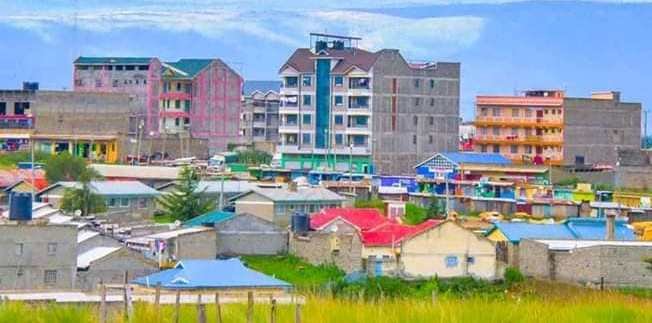
Ol’Kalou today
Virtually all the white owned farms were purchased in this way, including farms that had been purchased just a few years earlier, when the government was encouraging people to sell up all their assets in England and settle in Kenya. This pinchpenny buyback must have utterly ruined a great many people.
Even more breathtakingly incompetent, my parents received a letter from a relative in England who had just attended the Royal Show in Cambridge. There, they had encountered the stall of the Kenya Settlement Board and, having family over there (us), they had shown an interest. The people at the stall - government representatives, no less - had advised them that the Lancaster House Conference was going swimmingly and that Kenya was a fantastic place to settle. This, at the same time that the crown was buying up farms at pence on the pound! The letter said that they were about to sell up and move to Kenya, so rosy a picture had the board painted.
The only time by parents made an international phone call in their entire lives was to call these relatives and tell them the truth that the settlement board must have already known - that white settlement in Kenya was over, and that they absolutely should not come. As we didn’t have a phone on our farm, mum and dad had to trek out to a neighbour’s place to make this call.
Despite the situation, my parents were among the fortunate ones. Mum’s relatives in South Africa were wealthy sugar farmers and they helped Dad and Mum to purchase a farm in the Natal Midlands near Pietermaritzburg.
Interestingly, despite their experiences, my parents never had a bad word to say about Kenya. In fact, so positive were thay that our South African relatives would often prompt my mother to discuss Kenya by sayig, “Now tell us, Helen, what it was like in Utopia.” As for dad, all his anger was for the British, for their mishandling of the peace, the conflict, and the whole mess from start to finsih. He felt the settlers had been badly let down on every front, the authorities making life there untenable through their high handed governance, and then badly muddling the exit to boot.
Kenya finally became independent on December 12th, 1963. By then, I had already left to “get educated”, as my parents had urged me to do, and which had been arranged by mum. I have been back to the farm on several occasions. I still speak Swahili and the people on the farm know exactly who I am, and treat me with respect and politeness.
Our farm was split up into fifty acre lots, which all produces at subsistence level. When my parents ran the farm, it was easily able to sustain about 230 people. Less than half of that number is able to be supported by the same land now. None of the boreholes, which my parents painstakingly introduced, currently work. Now, the few head of cattle and the little household that runs them must haul water by donkey from the polluted Oleolondo river, half a km away.
Despite all the place names being Maasai, and the land itself originally a Maasai possession, all the occupying farmers are Kikuyu. None of the families who actually worked the land with my parents are there today. On a positive note, though, the new house my family built just before they left is now a school - a boarding facility for boys.
For my part, I value my Kenyan background immensely. It was a rich education in and of itself, teaching me about the ways of many very different peoples. But equally, I am far from pining for the status of landed gentry running a 1500 acre farm over a population of disenfranchised and starving locals. Or as a minority white farmer in a land full of people who have every reason to resent white farmers.
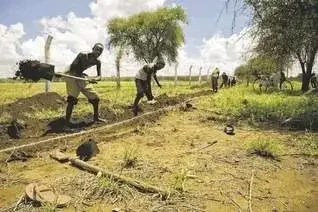
Maasai farmers in the Rift Valley today
To my mind, the whole enterprise was a farce and a tragedy from start to finish. The Empire fell almost accidentally into running a territory they knew nothing about, with scant regard for the people who were already there. And the scars they left have helped to ensure that, when the government hurriedly exited, clutching its wallet as it ran, the new government was faced with near insuperable disadvantages, and now oversee a country with highly fertile land that is heavily underused in an economy that is still far from developed. In a farcical irony, Kenya, once a breadbasket of the world, now imports massive amounts of grain from Ukraine. Yes, wartorn Ukraine produces more surplus than Kenya.
In the end, though, this is an instructive story. When we look for things to resist or oppose in the present day, we often look for black and white examples of exploitation and overreach. But when we see stories like the settlement of Kenya, and really dig into what it was like for the people on the ground, we find that the violence, tragedy, suffering, and rank incompetence of colonialism is often disguised as altruism and pragmatism. End the slave trade, protect our interests, feed the people, provide opportunity - all the stock phrases that accompany geopolitical promises and policies to this day. And which may, for all we know, be masking the next neo-colonial disaster that may or may not be brewing in the present day’s halls of power.