The British Settlement of Kenya - 3 of 4
PART 3 THE - BEGINNING OF THE END
We last left this story with an insurgency brewing in Kenya, and literally in our backyard. Under these circumstances, a natural question would be, “why didn’t you just leave?”. The answer to this question is similar to that of many immigrants who are told to “go back to where you came from”. The simple fact was that my father was, in all important aspects, an African. He had been born in Africa, the son of an Anglican missionary in Zululand. He spoke multiple African languages, had never set foot outside the continent all his life, and had bought a farm with funds from his father in law.
There is also the fact that the rebellion itself was very difficult to see clearly, especially in its earliest days. The then governor, Philip Mitchell, seems to have dedicated the latter part of his career to pretending that the uprising wasn’t happening. British authorities in general overwhelmingly accepted the work of racist academics who dismissed it as an atavistic wish to return to tribalism, when the fact is that the Kikuyu were politically sophisticated, having a long tradition of opposing political factions who would engage in mutual discussion and debate. The uprising itself, founded originally as a political party formed around Kikuyu and others who had fought for the British in various conflicts and had not been paid, really only turned militant after decades of getting nowhere politically. And to this day, there are some historians who see the rebellion as a Kikuyu civil war, given that at least as many Kikuyu fought for the British as against. With all this going on, it was hard to figure out what was actually happening.
My parents did in fact contemplate moving to New Zealand, but it was just too difficult. Mum’s family money was in the farm, and as mentioned before, my father was essentially an African and did not want to leave the land of his birth.
In 1951 our neighbour was murdered. The British authorities desperately avoided any possible mention of an insurgency, so six Kipsigis were quickly charged and hanged for the killing. My father, who was the first on scene, insisted that the weaponry used was Kikuyu and that the Kipsigis could not possibly have committed the murder. Dad was certain that the people on our farm, having committed themselves to the Mau-Mau, were responsible. The British authorities under Mitchell were not inclined to believe or even acknowledge this.
On January 1st, 1953, two farmers named Ferguson and Bingly were murdered in the Wanjohi, just a few miles from my parents farm. It is believed that they were killed by their own Kikuyu house servants, who had been oathed into the Mau-Mau. This style of killing was feared by the settlers, for obvious reasons, and for a great contemporary report on the brutality of the conflict, you can check out this Time Magazine feature here.
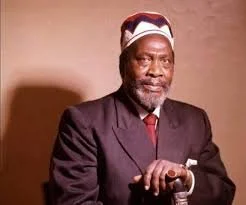
Jomo Kenyatta
This was the first murder acknowledged by the British as part of the Mau-Mau insurgency, and a new governor, replacing see no evil Mitchell, sucessfully petitioned London to declare a State of Emergency. Thousands of British troops were sent to Kenya, mostly National servicemen who knew nothing of the country. In later years, militias and commando units, with a sprinkling of opportunistic mercenaries, would spread mayhem and murder all through the land, prompting many back home in England to question both the necessity and legality of continual slaughter of native Kenyans.
Governor Sir Philip Mitchell, ‘an India man, knew next to nothing of Kenya, and his fate was sealed when the insurgency he insisted did not exist began murdering farmers in the Rift Valley, where my family had their farm. Swift to action, the British government replaced him with Sir Evelyn Baring, a scion of the British establishment, who knew even less about Kenya than Mitchell, but who was at least capable of admitting that things happening in front of him were, well, actually happening.
It may surprise you to learn that the British by this time had a long history of failed attempts to protect and increase native rights. Unrest and violent uprisings had been occurring since at least the 1930s, and the Mau-Mau itself had grown out of a non-violent activist movement that had engaged in discussions with the government. The issues that bedevilled these efforts were the fact that, for most of this period, highly conservative and appallingly racist elements dominated both the government at home and the administration in Kenya. Attempted reforms were therefore so conservative and limited as to be worthless, and this, paired with the tendency of colonial officials in Kenya to be paternalistic in attitude and brutal in operation, meant that settlement through dialogue seemed an unlikely solution.
So, given that the British authorities were determined to continue their policy of white settlement, and being disinclined to defuse the situation by perhaps talking to some of the local leaders, they instead organised a ‘show trial’ at the far western town of Kapenguria, far away from the Kikuyu epicentres of rebellion. Jomo Kenyatta, the future president, along with five others, were accused of runnign Mau-Mau operations, with Kenyatta charged as the Mau-Mau leader. He wasn’t even a member, being instead the head of a political association that advocated for Kikuyu independence.
All six were sentenced to imprisonment in Lodwar, a small town in Northwestern Kenya in Turkana country, west of Lake Rudolf. The Turkana were hostile to the Kikuyu, and this is a typical example of the divide and rule strategy the British employed. They would pit tribal groups against each other, offering various inducements, and a great many native Kenyans put their forces at British disposal, often as a way to settle tribal scores or expand their own territory and power. Along with this strategy, the British also instituted collective punishment, collective fines, a program of “villagisation” which, for loyalists, provided protection, but for everyone else operated essentially as a system of concentration camps. .
The Mau-Mau never really had a chance, militarily. A decentralised collection of forest dwelling gangs, bitterly divided ideologues, and well organised but very poorly armed operational units, the might of the British Empire crushed them with brutal efficiency. While many white settlers were killed, tens of thousands of native Kenyans were wiped out by battle hardened and heavily armed mainline troops, and highly motivated auxiliaries. By 1956 the security forces had essentially won the war, killing or capturing their leadership and eradicating the gangs in the forests. Of course, this was the wrong war to win entirely. Where the Mau-Mau fought most effectively was in their information war, with which the British could never adequately cope, and it was this psychological warfare that would eventually make the British position untenable.
My father had joined the Kenya Police Reserve as soon as the Emergency was declared. This meant that he was constantly on patrol, and occasionally called away to take part in operations in the nearby Aberdare mountains, where many of the gangs were based. This obviously disrupted the management of the farm and created security concerns in all the farming areas, with all the armed men away on patrol. I remember several occasions during school holidays when all of us children were compelled to huddle together in one of the larger houses, guarded by one of the older men, to keep us safe until our father’s returned from patrol.
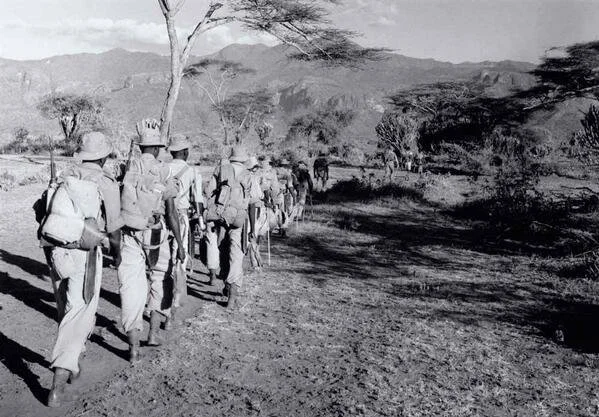
A Kenyan Police unit in training, circa 1950
In early 1953, all thirty of our resident Kikuyu families left the farm overnight. We understood they had been told to kill us all and dad knew that all of them had taken the Mau-Mau oath. It seemed that, unlike so many other places in the valley, our relationship with our Kikuyu workers were good, and they simply didn’t want to kill us. After they had gone, we found that all our equipment and buildings had been left spick and span, and they had taken nothing that didn’t belong to them. Perhaps they respected dad’s marksmanship and armament, but it’s also probable that they didn’t have much in the way of grievance with our family personally.
Dad and Mum then managed the farm with the five Luo families remaining. As the Luo were not involved in the uprising, they had not been oathed and had stayed. Dad replaced the Kikuyu families with thirty families of Wakamba, a people who were enemies of the Kikuyu and had long been an integral part of British security forces in the area.
Despite all that was happening, my family decided to build a new house in 1956, displaying unreasonable optimism. Awareness of the increasing tensions was never far away, however, and I remember my parents saying to me, ‘This farm will not be available for ever, so you had better get educated.’
With the British authorities erroneously convinced that they had quelled the most serious threat to white occupation, hundreds of Settlers were brought to Kenya from the early fifties onward under the auspices of the Kenya Settlement Board. An uncle of mine was responsible for settling dozens of mainly British settlers in Mau Narok, an area of ‘Crown Land’ just west of west of Nakuru.
It certainly wasn’t the end of the story though. Soon details emerged of the thirty or so detention camps housing what was termed as ‘hardcore’ Mau-Mau. The most notorious of these camps, known as Hola, was in a remote area of Kenya on the lower reaches of the Tana River. In March 1959 eleven prisoners were beaten to death and another 77 were badly wounded by the camp guards, under the supervision of British officers. This atrocity was the final straw. Quietly, and with desperate attempts to ignore or justify it, the long brutal tail end of a counterinsurgency had been winding its murderous way across the country. The concentration camps in all but name had continued to swell their numbers, and world opinion had been turning steadily against the occupation.
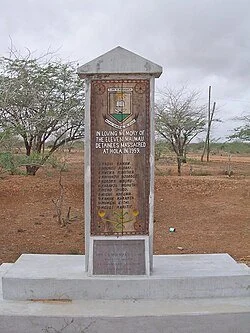
A monument to the Hola Camp Massacre
With the massacres in Hola, the British finally decided that they could hold onto Kenya no longer, as they realised they’d need a permanent garrison of enormous proportions to guarantee security in what had long been acknowledged as one of the most blatantly racist regimes in the world at the time.
So it was that finally, after more than a century of occupation and settlement, African nations such as Kenya began to gain their independence. During this period, both well intentioned initiatives and nakedly brutal reactions had resulted in bloodshed and suffering, as well as astronomical expense in lives and pounds sterling. In 1957, Ghana gained its freedom. In 1960, British PM Harold Macmillan made his famous “winds of change” speech, signalling the beginning of the end of the UK’s colonial adventures. The next year, the colonial office arranged the release of Jomo Kenyatta, and initiated the Lancaster House Conferences, a process which finally led to Kenyan independence in 1963.
In our next and final insalment, we’ll take a look at the aftermath of independence, and what lessons if any we can learn from these events.